



Content
The Scottish Highlands are famous for mountains and long-distance trails. You do not need to be a keen walker to enjoy them.
Some of the best views, historic sites and wildlife stops are only a few minutes from the car. Others need almost no walking at all.
This guide is for visitors who want to enjoy the Highlands without a demanding climb. It covers short walks and roadside viewpoints. You can also choose places based on how far you want to walk.
Enjoying the Highlands Without Long Walks
Many of my guests want to see the Highlands without spending hours on a walking trail.
My name is Aleman. I have spent thirty years driving visitors around these glens, lochs and coastlines from my home in Inverness.
Some guests are in their seventies or eighties. Others are travelling with young children. Some are recovering from an operation or simply want a more relaxed Highland day.
One question comes up again and again. Can we still see some of the best places in the Highlands when we only want to walk for ten or fifteen minutes at a time?
You certainly can.
The stops below are places I often use on my own tours. I have included practical notes about walking distance, slopes, steps, toilets and places to rest.
What to Know Before You Go
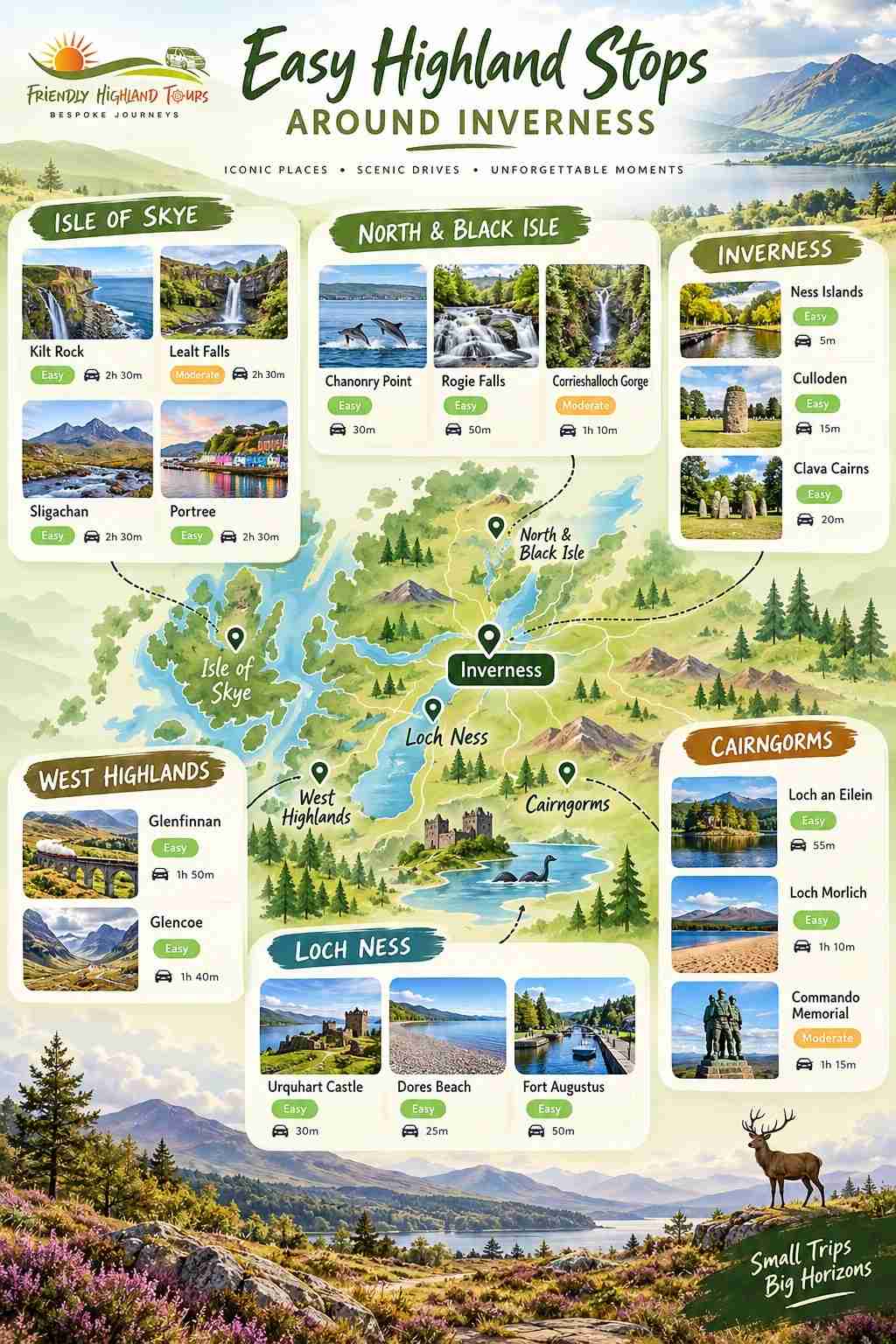
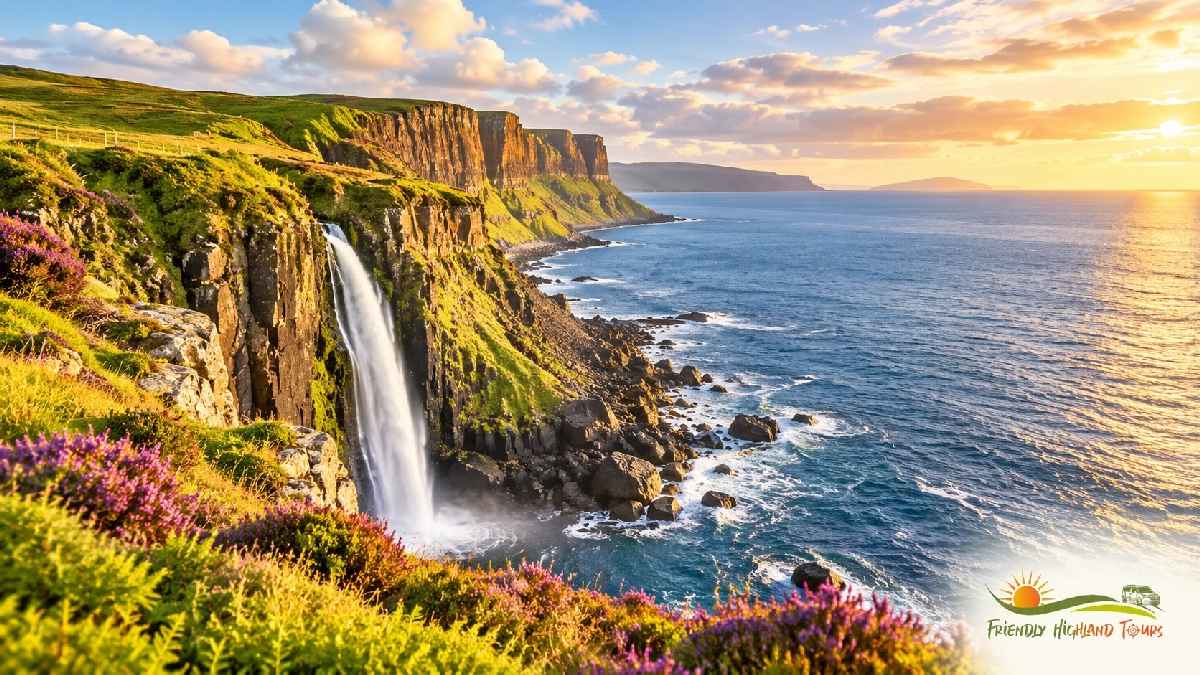
- Many impressive Highland views are only a few hundred metres from a car park. Kilt Rock, Culloden Battlefield and the Glenfinnan Monument are good examples.
- A short walk can still involve a steep climb on the way back. Urquhart Castle and the Falls of Foyers are good examples.
- Toilets, benches and cafe stops can matter just as much as distance.
- Wind, rain and shorter winter days can change how comfortable a path feels.
What Makes a Highland Stop Easy?
Distance from the car is only part of the story.
A 300-metre path on a steep slope may feel harder than a flat kilometre beside a loch. There are six things. I always check before recommending a stop.
- Distance from the car park. I count the return walk too.
- Gradient. A downhill walk to a castle or waterfall means an uphill walk afterwards.
- Steps. Even a short flight of uneven stone steps can be difficult for stiff knees or a walking frame.
- Surface. Tarmac and firm gravel are easier in most weather. Grass, shingle and tree roots can become slippery after rain.
- Places to rest. Benches and viewing platforms can make a big difference.
- Toilets. Many beautiful Highland stops have no facilities, so this needs to be part of the day plan. Pasted markdown
I use three simple levels in this guide. These are my own practical ratings from years of guiding rather than official accessibility grades.
| Level | What it means | Typical time on foot |
| Roadside | View from the car park or within about 50 metres on a level surface | Under 5 minutes |
| Short and gentle | Firm path, mostly level, a few minutes each way | 10 to 20 minutes return |
| Short with a slope | Good path but a steady climb or some steps | 20 to 40 minutes return |
Easy Walks Near Inverness
You do not need to travel far from Inverness for an easy Highland day.
These four stops are all within about twenty minutes of the city centre. They can work well on an arrival day or after a long journey north.
Ness Islands
Level: Short and gentle
The Ness Islands are wooded islands in the River Ness, linked to both riverbanks by Victorian suspension bridges.
The paths are flat. The full circuit is about 5 km. You can cross one of the bridges earlier to make the walk much shorter.
I often suggest a relaxed 20-minute loop from the Bught Park side.
Seals sometimes swim up the river between the bridges.
Whin Park is next door and has a playground, boating pond and cafe. This makes the area useful for families who want an easy stop close to the city.
Inverness Castle Viewpoint
Level: Short with a slope
The Inverness Castle Experience officially opened in February 2026 after major work on the former courthouse.
The site has views across the city and River Ness. There are also gardens, exhibitions and a cafe.
The castle stands on a small hill above the river. Reaching it from the main streets involves a short climb.
Anyone who needs step-free access should check the current arrangements with the venue before visiting. Arriving by car at the top can remove much of the uphill walk.
Culloden Battlefield
Level: Short and gentle
Culloden is one of the easier historic sites to visit around Inverness.
The National Trust for Scotland confirms that the battlefield paths and roof walkway are wheelchair accessible. The visitor centre is on one level and has accessible toilets and a café.
Mobility scooters have also been available to borrow at the site. Ask at the welcome desk about current availability.
The battlefield is exposed to the wind, so bring a warm layer even on a bright day.
Phone signal can be limited across the moor. Agreeing on a meeting point is useful when members of a group want to explore separately.
Clava Cairns
Level: Short and gentle
Clava Cairns is a group of Bronze Age burial cairns around five minutes by car from Culloden.
Entry is free and parking is beside the site. The stones stand in a peaceful clearing among trees, and the main area is fairly level.
The ground is grass and gravel, so expect some uneven patches. It can also become muddy after rain.
There are no toilets or staff on site.
The access road is narrow and single-track in places. The narrow access road can be awkward for visitors who do not know the area.
Gentle Stops Around Loch Ness
Loch Ness is one of the places almost every first-time visitor wants to see.
You can enjoy the loch without a long walk. The main thing to know is that some famous attractions around it involve more climbing than people expect.
Urquhart Castle
Level: Short with a slope
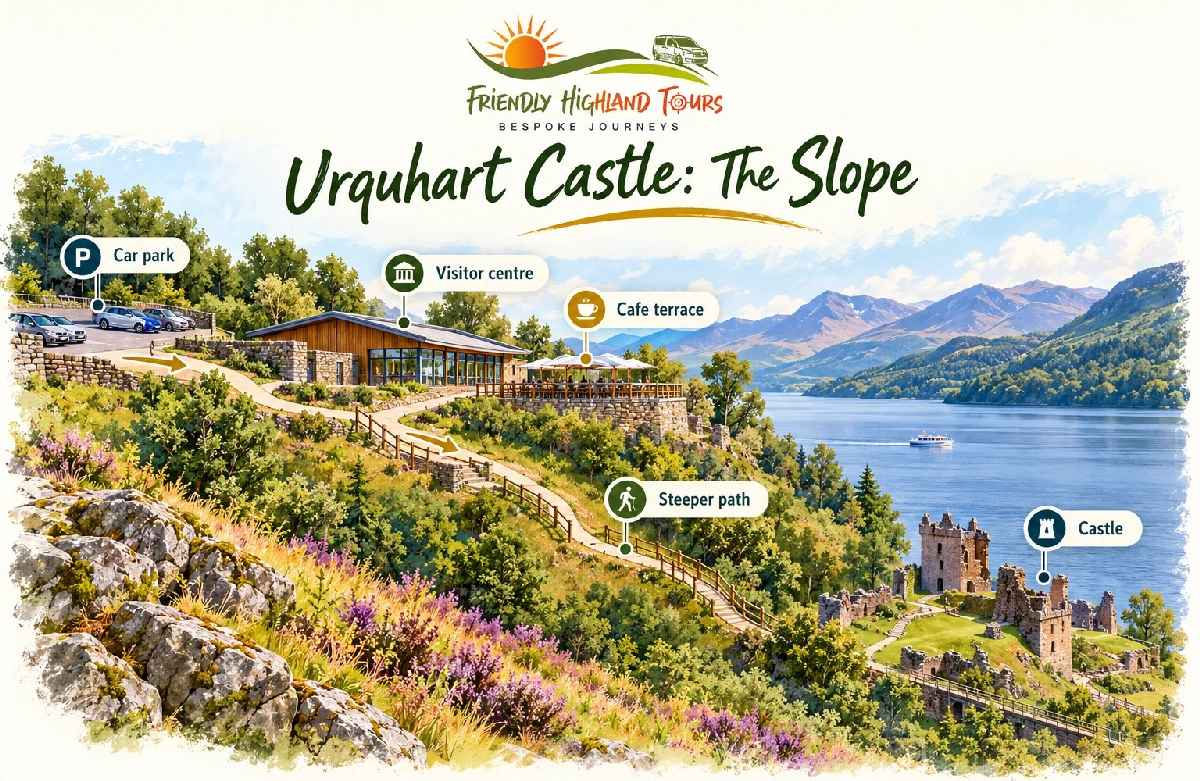
Urquhart Castle stands on a headland below the main road.
A steep tarmac ramp leads to the visitor centre. From there, another steep path goes down to the castle. Some parts of the ruins also have steep steps.
Some guests prefer not to make the full descent. The cafe and terrace above the castle still give a very good view.
The site has mobility scooters and wheelchairs available on a first come, first served basis. Carers of disabled visitors can receive free entry when added to the booking.
Opening times change through the year. Check Historic Environment Scotland before travelling.
Large rucksacks and suitcases are not permitted inside. Dogs are also not allowed.
Dores Beach
Level: Roadside
Dores is a small village at the northern end of Loch Ness. It is about twenty minutes from Inverness.
The car park is beside the shingle beach and gives a clear view along the length of the loch.
On a calm morning, it is one of my favourite photo stops.
The shingle can be loose underfoot. Many guests prefer the view from the edge of the car park.
The Dores Inn is next door for a warm drink and a toilet stop.
Fort Augustus Locks
Level: Short and gentle
Fort Augustus is at the southern end of Loch Ness. The Caledonian Canal runs through the village and climbs through a staircase of locks.
The towpaths beside the locks are flat. Cafés, benches and toilets are only a short distance away.
Watching boats move through the locks can be a relaxed way to spend half an hour.
Fort Augustus is around an hour from Inverness by road and can fit into a full Loch Ness private tour.
The Black Isle and Northern Highlands
North of Inverness, the roads become quieter and the scenery changes quickly.
These stops can fit into my North Highland private tour. Each gives you something memorable without needing a long walk.
Chanonry Point
Level: Roadside to short and gentle
Chanonry Point is a narrow shingle spit on the Black Isle. A lighthouse stands at the end.
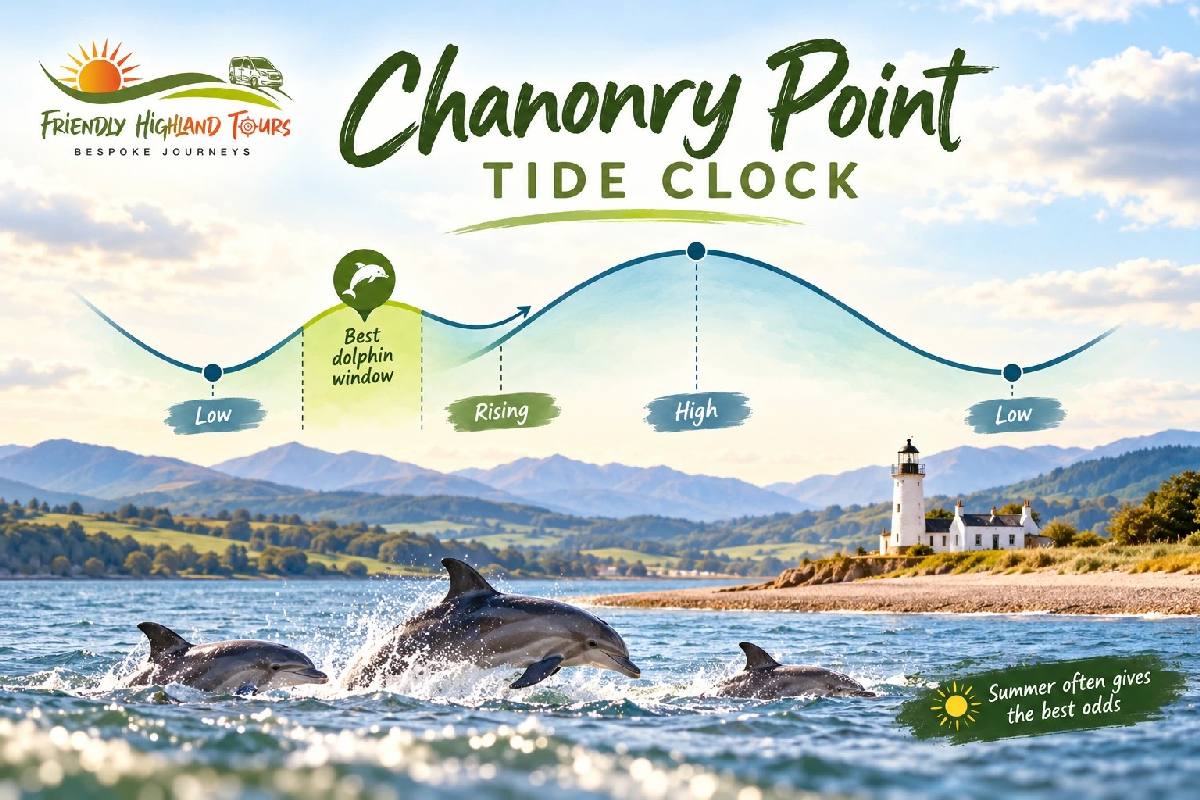
Bottlenose dolphins feed in the fast-moving water around the point. This has made Chanonry Point one of the best-known places in the UK for watching dolphins from land.
Parking is limited and can fill quickly on good-weather days.
The beach is shingle. Guests who prefer firmer ground can watch from around the lighthouse.
The point is exposed to the wind in every season. A windproof jacket is useful.
Dolphins can appear throughout the year. Summer often brings better chances as salmon travel through the Moray Firth towards the rivers.
Rogie Falls
Level: Short with a slope
Rogie Falls is a broad waterfall on the Black Water. It is about thirty minutes west of Inverness.
A woodland path leads from the car park to a viewing platform and suspension bridge. Most visitors reach the falls in around ten minutes.
The path drops towards the river and includes steeper sections and uneven steps. The return walk is the harder part.
Wild salmon may be seen jumping at the falls during the late summer season.
Seasonal toilets are available at the car park from April to October, and parking charges apply.
Corrieshalloch Gorge
Level: Short with a slope, with an easier option
Corrieshalloch Gorge is near Ullapool, around 46 miles from Inverness.
A Victorian suspension bridge crosses the gorge above the 45-metre Falls of Measach.
The National Trust for Scotland has a Gateway to Nature Centre at the site. Toilets and a takeaway cafe are also available.
The path from the centre to the bridge is about 800 metres. It has no steps but does rise and fall in places. Four benches are available along the way.
A separate easier route is suitable for wheelchairs and pushchairs. It leads to a bench overlooking Loch Broom.
Only six people can stand on the suspension bridge at one time. The bridge also moves slightly underfoot.
Winter opening arrangements differ from summer. Check the National Trust for Scotland website before travelling later in the year.
Easy Highland Stops in the Cairngorms
The Cairngorms National Park has several well-maintained paths that work for visitors who prefer shorter walks.
Aviemore is around forty minutes south of Inverness on the A9. Both stops below are only a short drive from the town.
Loch an Eilein
Level: Short and gentle
Loch an Eilein lies within the old Caledonian pine forest of the Rothiemurchus Estate.
A ruined 13th-century castle stands on a small island close to the shore.
The water is only a few minutes from the car park. The first section of the path along the northern shore is wide and fairly level.
The full circuit is about 8 km. You do not need to walk the whole route to enjoy the loch. A ten-minute stroll is enough to enjoy the classic view towards the island castle.
Toilets and a small kiosk are beside the car park. Parking charges apply.
Red squirrels and crested tits can sometimes be seen in the surrounding woodland.
Loch Morlich
Level: Roadside
Loch Morlich has a sandy beach below the Cairngorm mountains.
The road runs alongside the loch. You can step out of the car and enjoy a wide mountain view without a long walk.
The higher slopes may be covered in snow during autumn and winter. The beach can still remain green.
The Glenmore area also has an all-abilities forest path.
Both places can be included in a Cairngorms private tour.
Easy Photo Stops in the West Highlands
The road from Inverness towards Fort William and Glencoe has some of Scotland’s most recognisable scenery.
This route can mean a long day in the vehicle. I prefer stops that give guests a good view without adding much walking.
Commando Memorial
Level: Roadside
The Commando Memorial stands just outside Spean Bridge.
It honours the commandos who trained in this part of Scotland during the Second World War.
The memorial is only a few steps from the car park.
A clear day gives you views towards Ben Nevis and the Aonach mountains. It is one of the easiest places to enjoy a large mountain view without a long walk. Pasted markdown
Glenfinnan
Level: Roadside to short with a slope
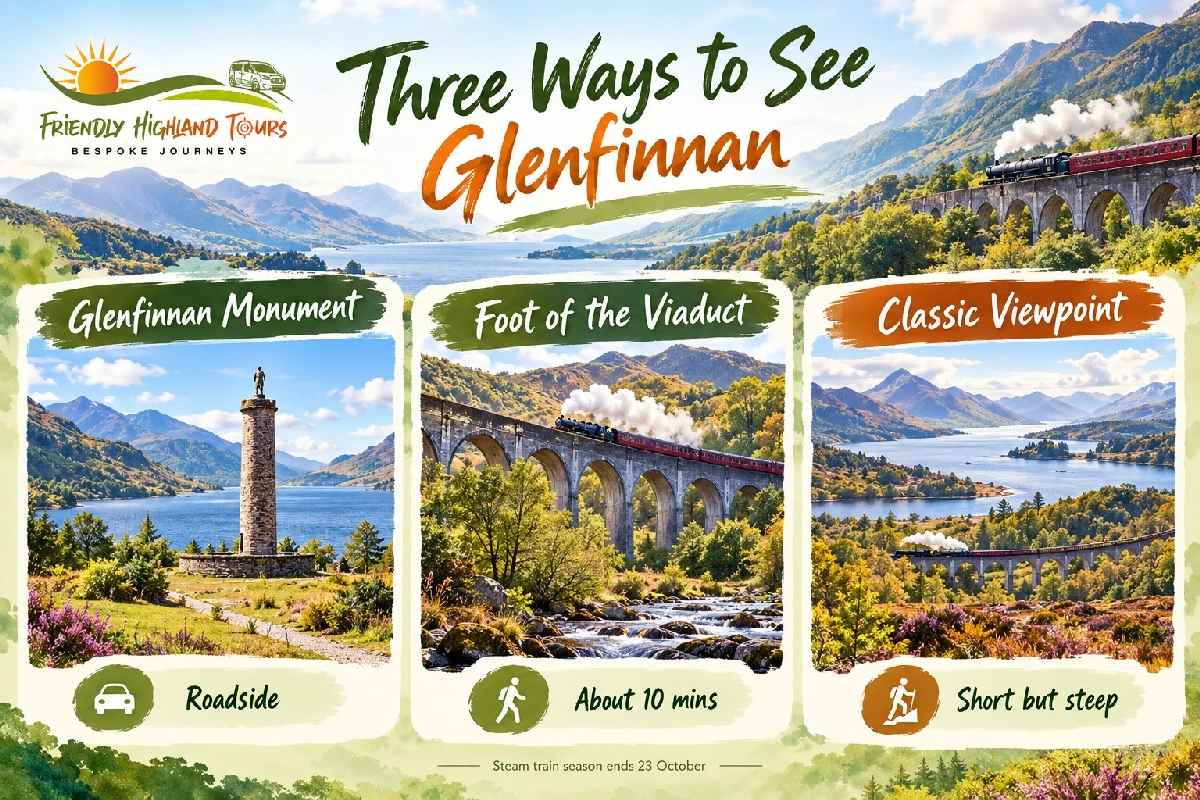
Glenfinnan has several viewing options. Guests can choose the one that matches how much walking they want to do.
- Glenfinnan Monument: A short paved path runs from the visitor centre to the monument beside Loch Shiel.
- Foot of the viaduct: An easy path leads towards the base of the arches. Allow around ten minutes each way.
- Classic viewpoint: The well-known view of the curved viaduct comes from the hillside behind the visitor centre. The path is short but steep and narrow.
Anyone hoping to see the Jacobite steam train should check the operating dates before planning the day.
Guests who do not want the climb can still get a good view from around the foot of the viaduct.
Glencoe Viewpoints
Level: Roadside
Glencoe is one of those places where the drive itself is part of the experience.
Several lay-bys along the A82 face the Three Sisters and surrounding mountains.
The National Trust for Scotland visitor centre further down the glen has toilets, a café and level paths.
The roadside stops can become busy in summer. I choose places where guests can step out safely away from the traffic.
These viewpoints form part of my Glenfinnan and Glencoe tour.
Easy Stops on the Isle of Skye
Skye has some demanding walks, including the Old Man of Storr and parts of the Quiraing.
You can still see a great deal of the island without tackling either of them.
A full day on Skye from Inverness can last ten or eleven hours. I keep the stops shorter and include regular breaks.
Kilt Rock and Mealt Falls
Level: Roadside
Kilt Rock is a sea cliff on the Trotternish coast. Its basalt columns resemble the pleats of a kilt.
Mealt Falls drops over the cliff beside it and into the sea.
The viewing area is less than 40 metres from the car park. This makes Kilt Rock one of the easiest major sights on Skye to reach.
The car park is chargeable during the day.
There are no toilets at the viewpoint. Public toilets are available in Staffin a little further north.
The viewpoint is also part of the Hebridean Whale Trail. Keep an eye on the water for dolphins and porpoises.
Lealt Falls
Level: Short and gentle
Lealt Falls is only a few minutes south of Kilt Rock.
Short paths from the car park lead to two viewpoints. One looks across the gorge and waterfall. The other faces the sea.
Steps continue towards the shore. The main views can still be enjoyed without going down them.
Sligachan Old Bridge
Level: Roadside
The old stone bridge at Sligachan crosses the river below the Black Cuillin mountains.
The bridge is right beside the road and the Sligachan Hotel.
Local legend says that dipping your face in the river brings eternal beauty. I leave that part to the braver guests.
Portree Harbour
Level: Roadside to short with a slope
Portree is Skye’s main town and a useful place for lunch and a toilet break.
The brightly coloured houses around the harbour are one of the island’s most photographed views.
You can see them clearly from the road above the harbour without taking the steeper lane down to the waterfront.
All four of these stops can be included in an Isle of Skye private tour planned around shorter walks.
Popular Highland Stops That Need More Walking
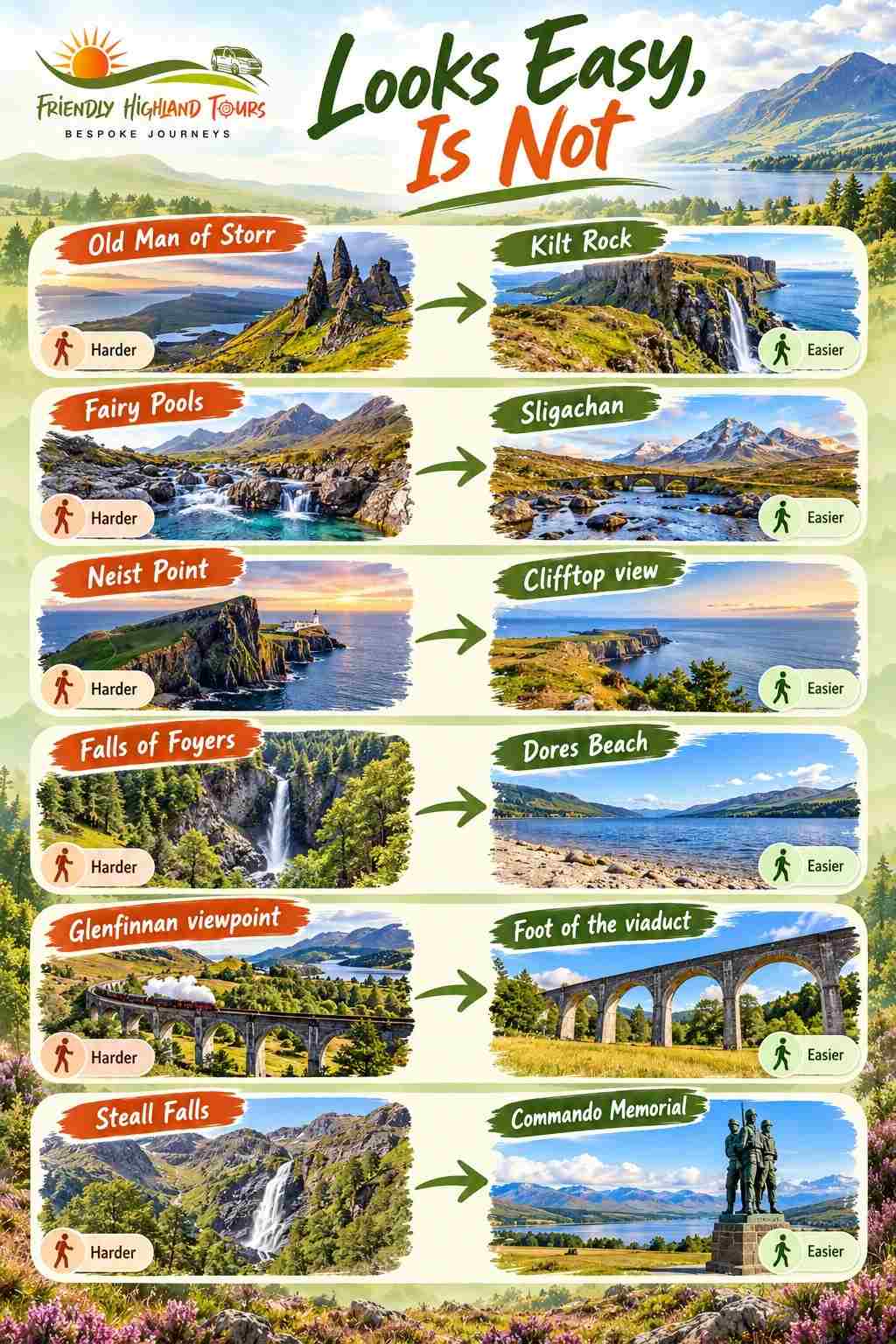
Some famous Highland attractions are often described as easy walks. They can feel very different for someone with limited mobility.
The table below gives a more comfortable alternative for each one.
| Stop | What makes it harder | Gentler alternative |
| Old Man of Storr, Skye | About 4 km return and around 250 metres of climbing on a rough path | Kilt Rock and Lealt Falls |
| Fairy Pools, Skye | Around 2.5 km return on uneven ground with stream crossings after rain | Sligachan Old Bridge |
| Neist Point, Skye | Steep steps towards the lighthouse and a hard climb back | Clifftop view from the car park end of the path |
| Falls of Foyers, Loch Ness | Steep paths and many steps to the lower viewpoint | Dores Beach or the terrace above Urquhart Castle |
| Glenfinnan classic viewpoint | Short but steep and narrow, often busy around train times | Level path towards the foot of the viaduct |
| Steall Falls, Glen Nevis | Rocky gorge path with drops beside it | Commando Memorial view towards Ben Nevis |
These places are not out of reach for everyone. Many active older visitors manage them comfortably.
The important thing is knowing what the walk involves before you arrive.
Planning a Comfortable Highland Day
A relaxed day depends on more than choosing short walks.
Toilets, rest stops, weather and where the vehicle can stop all make a difference.
Toilets and Rest Breaks
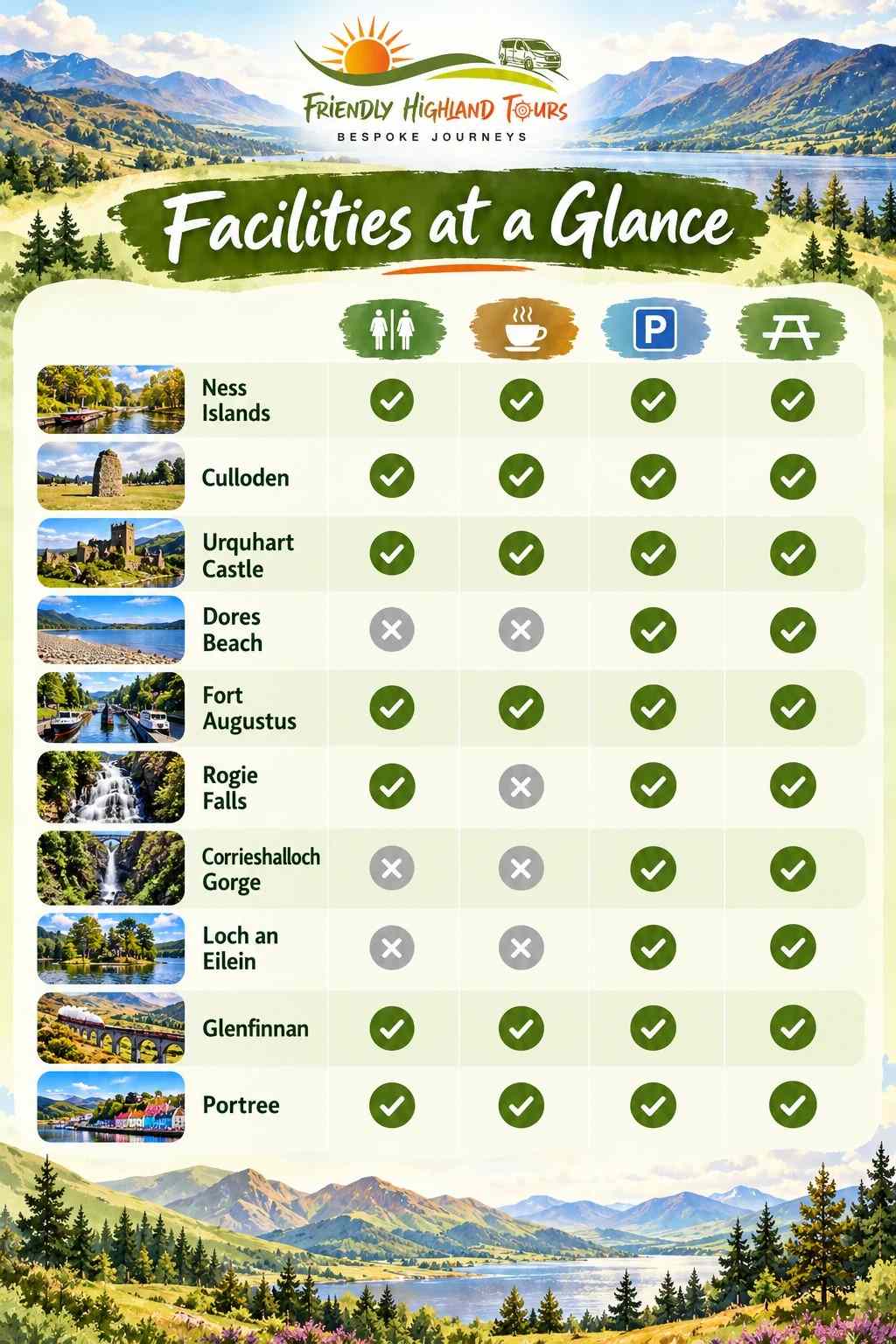
Public toilets can be limited in rural parts of the Highlands. Some are seasonal.
Rogie Falls, for example, has toilets from April to October.
I usually plan the route around visitor centres, cafes and hotels. These places tend to have more reliable facilities.
Culloden, Urquhart Castle, Corrieshalloch Gorge and the Glencoe visitor centre all have toilets.
Fort Augustus, Portree and Aviemore also have cafés within a relatively short walk of parking.
Many Skye viewpoints have no facilities. Portree or Staffin can be useful places for a break before travelling further along the coast.
Mobility Aids and Carer Tickets
Several major attractions provide mobility equipment.
Urquhart Castle has mobility scooters and wheelchairs available. Historic Environment Scotland also offers free admission for accompanying carers.
Culloden has also provided mobility equipment through its welcome desk.
For detailed accessibility reviews from disabled visitors, Euan’s Guide and AccessAble are useful resources.
They can include practical information about parking bays, slopes, door widths and other details that matter on the day.
Weather, Daylight and Footwear
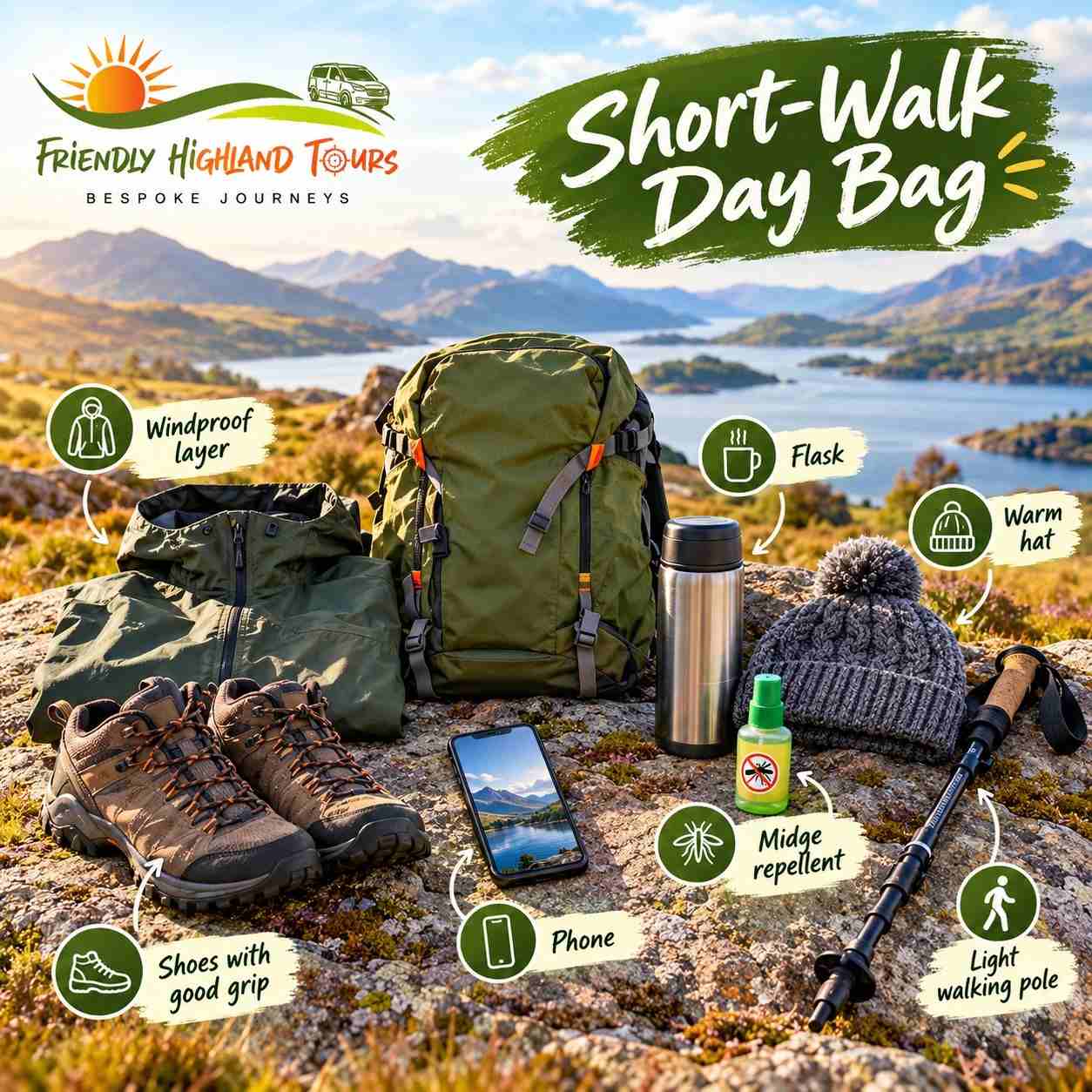
- Wind can make exposed places such as Chanonry Point and Culloden feel much colder.
- Grass and shingle become slippery after rain. Shoes with good grip are useful even for short walks.
- A light walking pole can give extra confidence on downhill paths.
- Opening hours become shorter from October onwards. Plan places involving more walking for the middle of the day.
- Midges are most active from late May to September, particularly on still and damp evenings in the west.
My Highland winter guide has more information about daylight and winter conditions.
Getting Close to the Entrance
The walk across a busy car park can sometimes be longer than the walk to the viewpoint itself.
On my private tours from Inverness give me more flexibility with drop-off points. I can often collect guests from the same place afterwards.
This can remove a lot of unnecessary walking during the day. It also gives each guest more control over how far they want to go.
Sample Highland Days With Short Walks
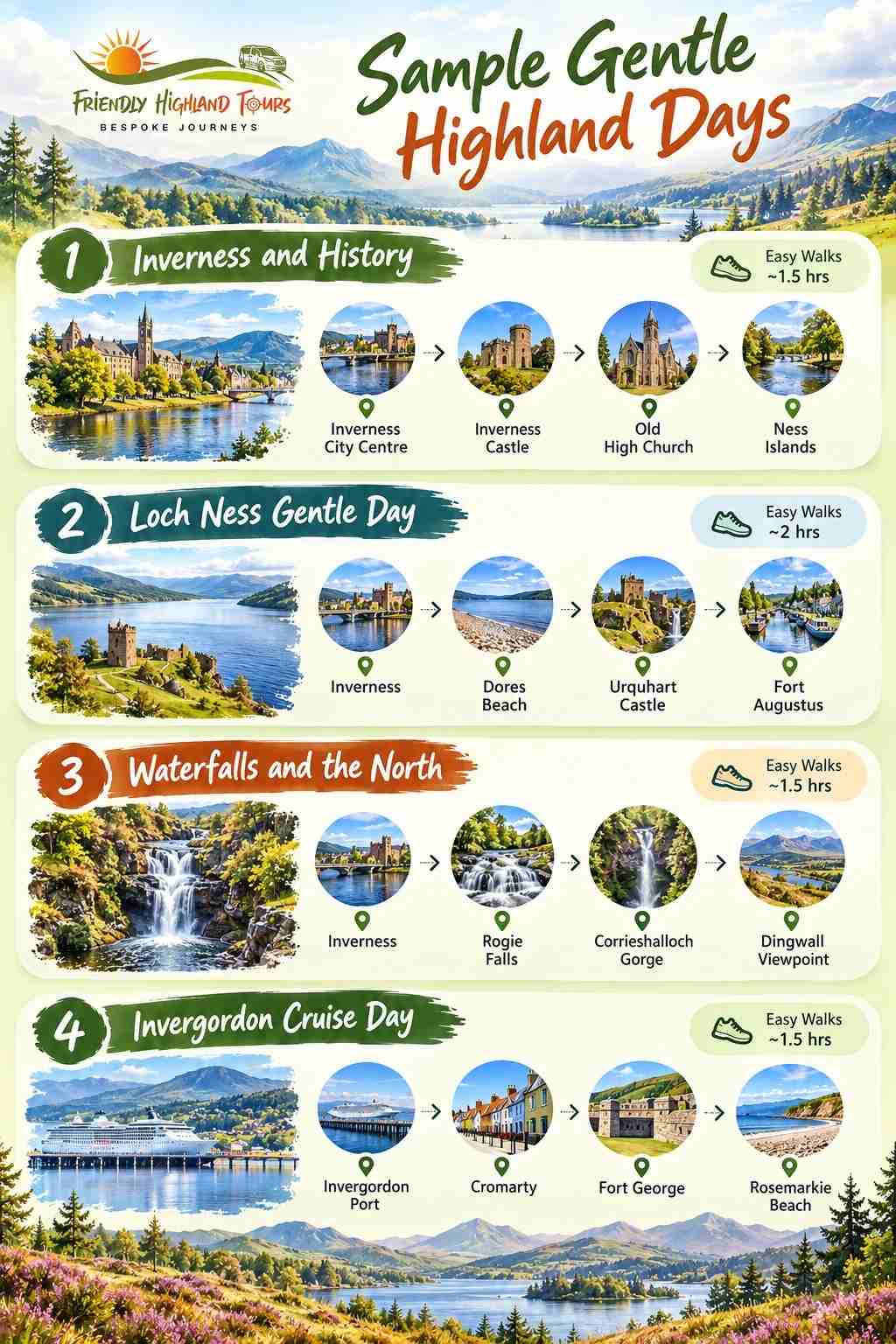
These are four examples of days I often build for guests who prefer shorter walks.
The walking times are rough estimates for an unhurried visitor and include the walk back to the vehicle.
| Day | Stops | Approximate walking in total |
| Inverness and history | Ness Islands, Culloden Battlefield, Clava Cairns, Dores Beach | 60 to 80 minutes |
| Loch Ness gentle day | Dores Beach, Urquhart Castle terrace, Fort Augustus locks, south shore drive | 40 to 60 minutes |
| Waterfalls and the north | Rogie Falls, Corrieshalloch Gorge, Chanonry Point | 60 to 90 minutes |
| Cruise day from Invergordon | Chanonry Point, Culloden Battlefield, Clava Cairns | 45 to 60 minutes |
Cruise passengers have a fixed return time, so the Invergordon route keeps the driving relatively short.
My Invergordon cruise tours are planned around the ship timetable.
Families with younger children may prefer Inverness day. Whin Park has a playground. Culloden has plenty of open space. Clava Cairns gives children something very different to see.
My family guide has more ideas for Highland days with children. Pasted markdown
Frequently Asked Questions
Are There Wheelchair-Accessible Walks in the Scottish Highlands?
There are several good options.
Disability Information Scotland lists all-abilities routes at Glenmore near Aviemore and Creag Meagaidh near Laggan.
The Cairngorms National Park also provides information about accessible trails, parking and mobility vehicle hire.
What Is the Best Time of Year for a Gentle Highland Trip?
May, June and September can work well for visitors who prefer shorter walks.
Days are long, most attractions keep their main-season opening hours and roads can be quieter than during July and August.
Opening hours are shorter from October onwards. This gives you less time to fit several stops into one day.
Do I Need to Book Highland Attractions in Advance?
Booking ahead is sensible for the busiest attractions.
Historic Environment Scotland recommends advance booking for Urquhart Castle to help guarantee entry.
Outdoor stops such as Clava Cairns, Kilt Rock and the Commando Memorial do not need tickets.
Can I Bring My Dog to These Stops?
Rules vary by location.
Dogs are not permitted at Urquhart Castle.
Culloden welcomes dogs outdoors and has a dog-walking field behind the visitor centre.
Open-air locations such as Clava Cairns, Loch an Eilein and Dores Beach are generally suitable for dogs kept under control.
Can I Reach These Stops by Public Transport?
Some places have public transport nearby.
Urquhart Castle has a bus stop within 150 metres of the entrance, and buses travel from Inverness towards Culloden.
Clava Cairns, Rogie Falls, Corrieshalloch Gorge and many Skye viewpoints have limited or no convenient public transport.
How Long Is a Private Day Tour From Inverness?
My day tours range from around seven hours for Loch Ness to ten or eleven hours for Skye and Glenfinnan.
Some guests tire more quickly during a full day. For them, I usually recommend a closer destination and more regular rest stops.
A custom private tour gives us more freedom to shape the day around your group. Pasted markdown
Enjoy the Highlands at Your Own Comfort Level
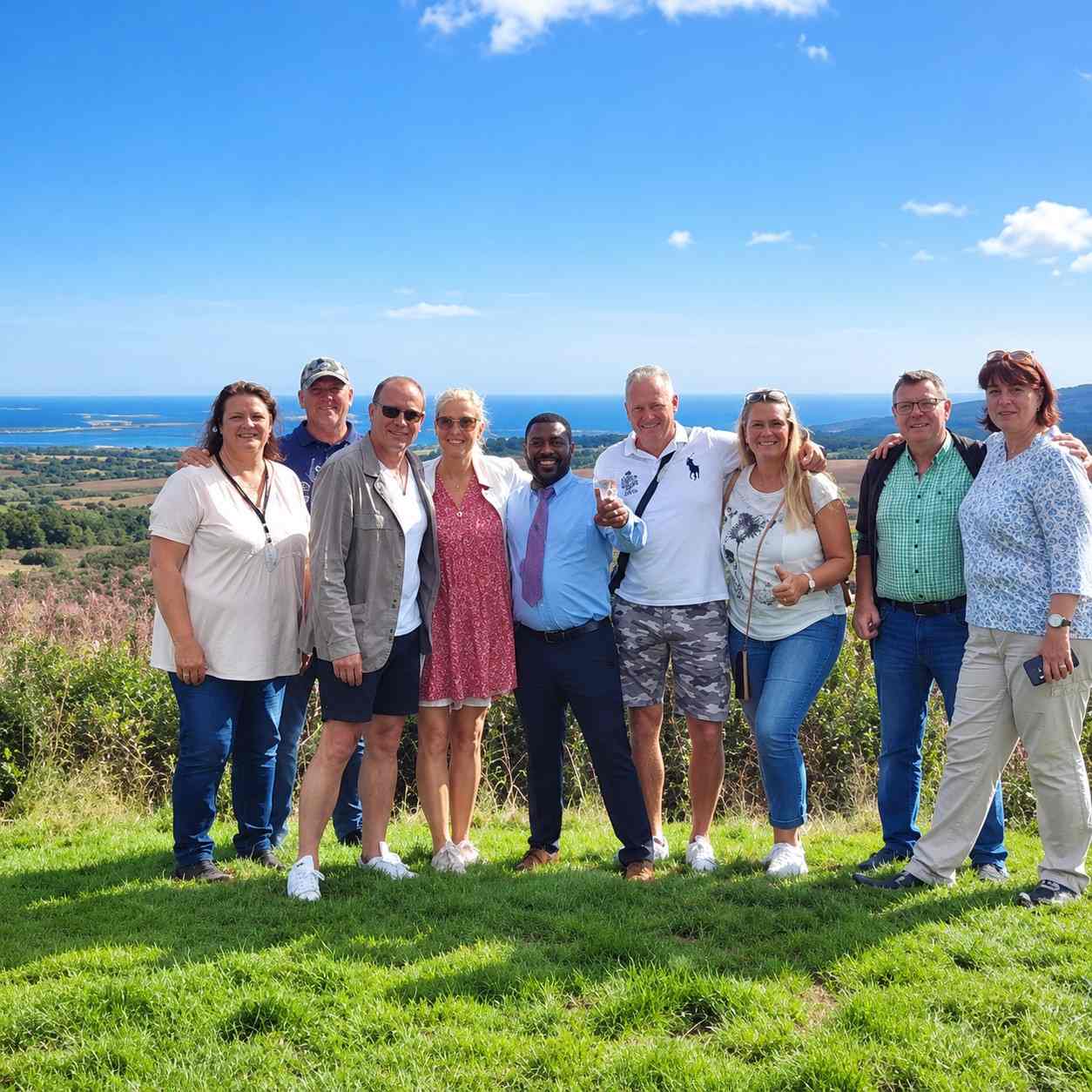
You do not need a long hike to have a memorable Highland day.
Some of my favourite tours have involved less than an hour of walking. Guests have watched dolphins at Chanonry Point. Others have spent time at Culloden or enjoyed Loch Ness from the terrace above Urquhart Castle.
The important thing is choosing stops that work for your group.
You can still include castles, waterfalls and wildlife. Mountain views can also be part of the day. Shorter walks and regular breaks make the trip more comfortable.
Ready to plan your trip? Browse my private Highland tours or get in touch and tell me what would make the day comfortable for you.
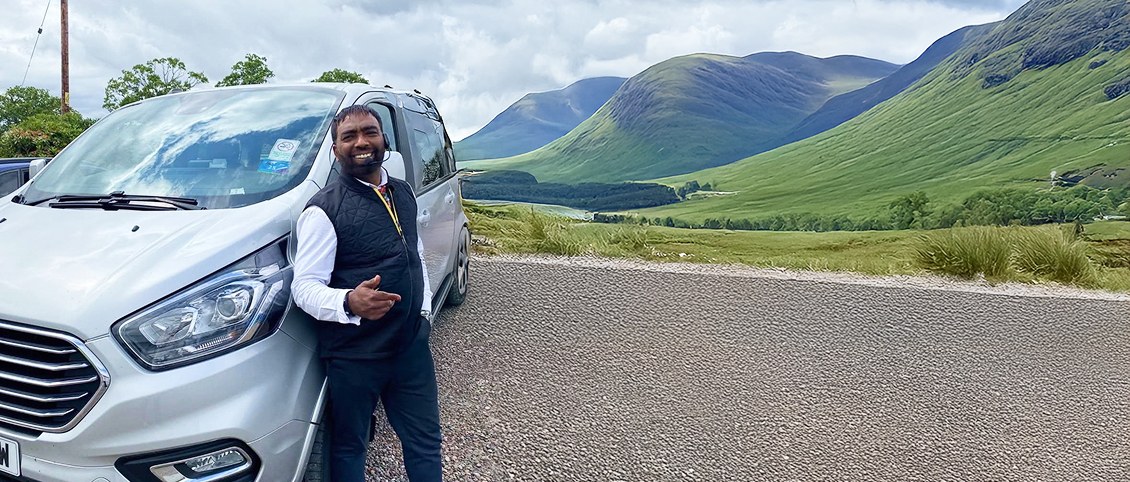
Aleman is a local guide who leads Friendly Highland Tours. He has lived in the Highlands for over thirty years. He knows the land through real journeys on quiet roads, lochs, and glens. Families and small groups travel with him for calm days and warm stories. Each guide he writes comes from experience on the road and careful consideration.