



Content
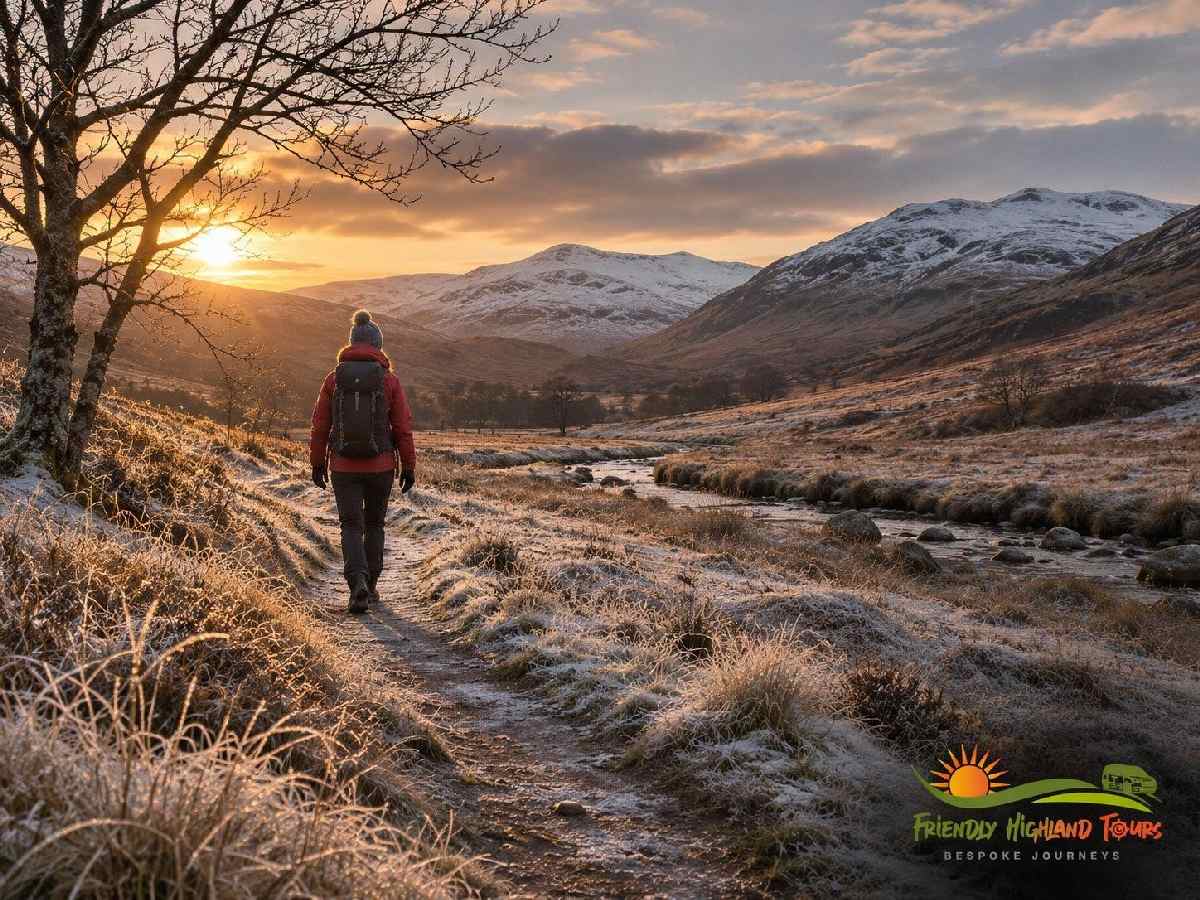
Winter daylight in the Highlands is short and your route should fit around the light. Set a hard finish time before you choose where to walk. Pick low and sheltered ground when conditions are uncertain. Published walk times assume reasonable conditions so expect a winter walk to take longer. Check sunrise, sunset, the forecast and road access just before you leave. Fix your turnaround time at home and stick to it on the hill.
Why Short Routes Suit a Highland Winter
Winter in the Highlands squeezes the whole day into a narrow window of useful light. The ground underfoot is also slower than it looks on a map. A route that felt casual in July can turn into a committing day in February. This makes winter planning feel more serious than at any other time of year.
This guide from Aleman at Friendly Highland Tours does not give a ranked list of the best short routes. No honest list exists because the right route depends on the weather, snow line, road access and light on the day. Your own experience matters just as much as the conditions. The guide gives you Highland winter context and a simple method for choosing and timing a short route. You can use this method for any walk in any Highland winter. Aleman’s guide on visiting the Scottish Highlands in winter can help when you are still deciding on a winter trip.
Key Facts About Winter Daylight in Scotland
These are the main points of this guide and the sections below explain each one.
- Daylight: The northern latitude of the Highlands gives a much larger yearly swing in daylight than further south in the UK.
- Ground: Higher ground in eastern Scotland gets far more snow days and wet days than the coast.
- Conditions: Weather, streams and road access can all change during a single day.
- Planning: Set your finish time first and then choose a route that fits it.
- Timing: Treat published walk times as a minimum and fix your turnaround time before you leave.
Why Highland Winter Days Leave Little Room for Error
The seasonal swing in daylight grows bigger the further north you go. The Highlands lie at the northern end of the UK. Days shorten towards midwinter more sharply here than in the Peak District or the South West. Inverness gets about six and a half hours of daylight at the winter solstice around 21 December. The effect is about more than simply having fewer hours of light. Usable light arrives late in the morning and fades early in the afternoon. The light at both ends of the day is also poor. Heavy clouds makes this worse and so does a steep-sided glen. The sun may never properly reach you in a deep glen at all.
People tend to blur two different ideas of winter together. The first is the everyday idea of the cold and dark months from December to February. The second is the shortest-daylight period around the winter solstice in late December. The solstice is the turning point for daylight but it does not mark better walking conditions. Met Office data shows that January is the coldest month in eastern Scotland although the days grow longer after the solstice.
Highland winter daylight hours change by date and by place. Sunset in Torridon is not the same as sunset in Aviemore. Early December and late February also differ a great deal. That is why this guide does not quote fixed hours of daylight. It gives you a method for finding and using the real figures for your day.
What Winter Does to the Ground Underfoot
The clearest picture of Scottish winter conditions comes from Met Office regional climate data for eastern Scotland. This region includes the Grampians and two findings stand out for walkers.
The first finding is that January is the coldest month in eastern Scotland. Mean daily minimum temperatures drop below -2°C over higher ground. The pattern matters more to walkers than the exact number. Frozen ground is likely and freeze-thaw cycles create ice that turns easy paths into awkward ones.
The second finding is the large gap between the coast and the hills. The Met Office records about 30 wet days in winter along some coasts. This rises to over 55 wet days in the Grampian mountains. Snow falls on about 20 days per winter along the coast and on over 80 days over the Grampians. Snow lies on the ground for over 60 days on higher ground in the Grampian.
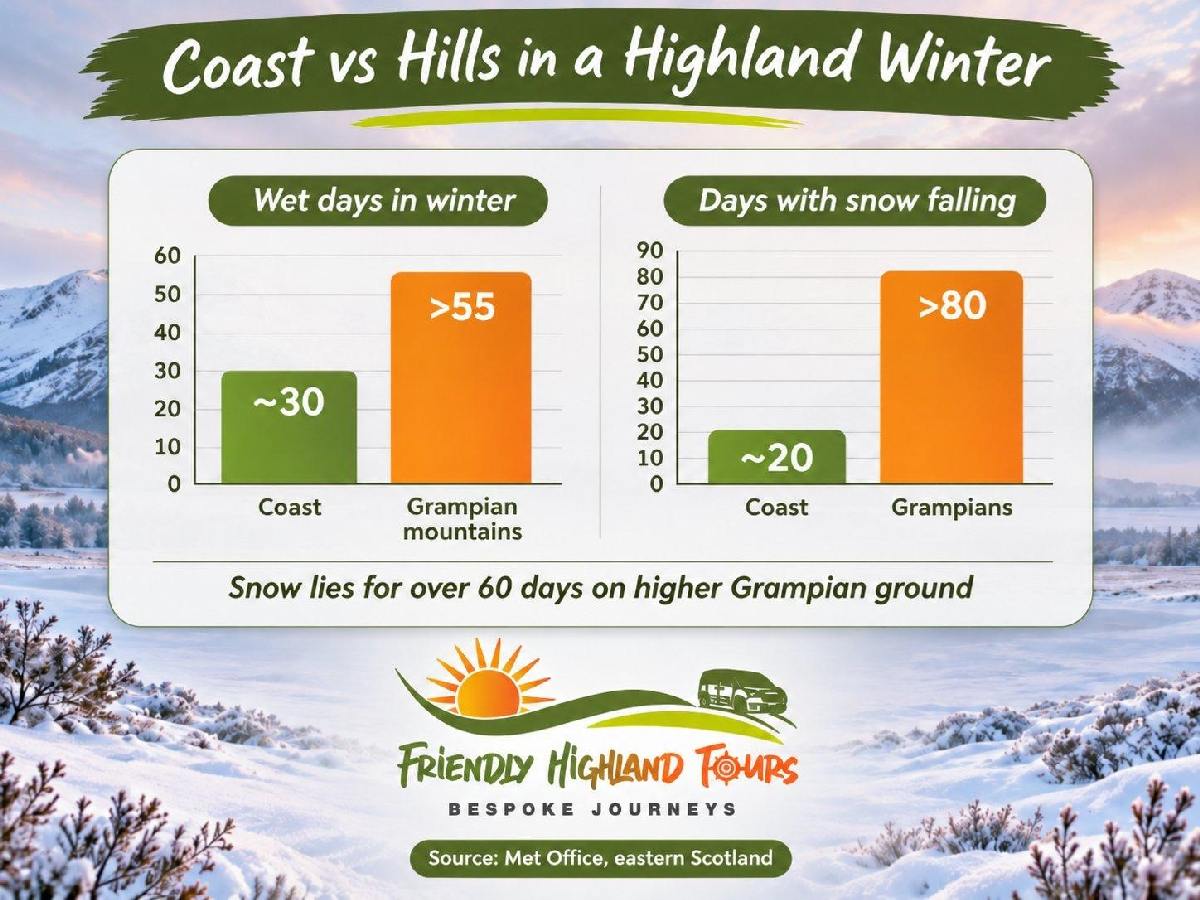
These figures make the planning lesson very clear when you compare them. A low coastal or glen walk and a route onto higher ground are different days out in winter. Each one carries its own chance of snow cover, wet ground, ice and poor visibility on the same day. Altitude changes the difficulty of a winter day more than any other factor. Keep this in mind whenever daylight is tight.
One caveat: These are regional averages for eastern Scotland and the Grampians. The wetter and milder west behaves differently and so does the far north-west. No regional average can tell you what a specific corrie is doing on a specific morning. Treat the figures as a reason to respect the high ground and not as a forecast.
How Scottish Winter Walking Differs From England and Wales
Ordnance Survey has a guide to hiking in Scotland versus England and Wales. It draws on Scottish Mountain Rescue expertise and covers the differences that matter most when daylight is short.
Weather changes fast. Scotland’s mountains can see rapid shifts in snow, ice, thaw and freeze. The conditions at the start of your walk may not be the ones you walk back through. A thaw partway through the day changes the ground as much as fresh snow does.
Navigation becomes critical. Good navigation is essential in poor winter weather. Paths can disappear under snow and familiar features can vanish in cloud. A wrong turn costs more when little light is left to correct it.
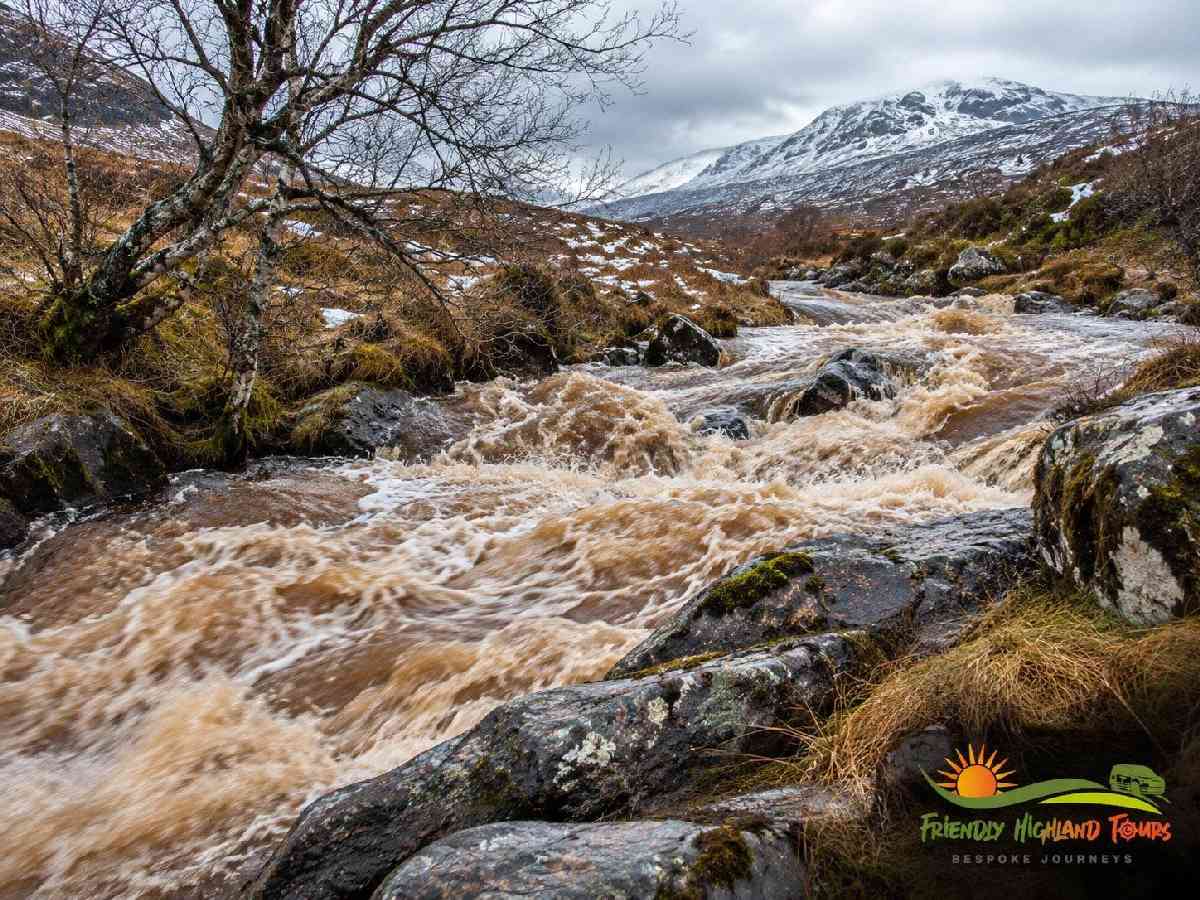
Water becomes an obstacle. Heavy rain and snowmelt together can make the smallest streams impassable. A burn you crossed easily on the way out may block your way back. This is a real problem on a route that depends on a single crossing.
Access isn’t guaranteed. Some roads may be blocked and snow gates may be closed. This can stop you from reaching the start point or make the drive much longer. It can also close the exit you planned to use.
Summer grades stop applying. Some walks that are simple summer hill days become serious mountaineering in snow and ice. Route choice needs extra care in winter for this reason. The guide also points to pacing and timing as important skills on high plateau ground.
These points explain why a short and simple route beats an ambitious one when light is limited. They also explain why turning back early is a normal part of winter walking in Scotland and not a failure. The weather may close in or a stream may look doubtful. You may also be moving more slowly than you planned. Reversing your route is the right response in each of these cases. A short and simple route is far easier to reverse than a long one.
Six Steps to Choose a Short Winter Route
Most people pick the route they like first and then check whether it fits the day. This order works backwards in winter and it helps to turn it around.
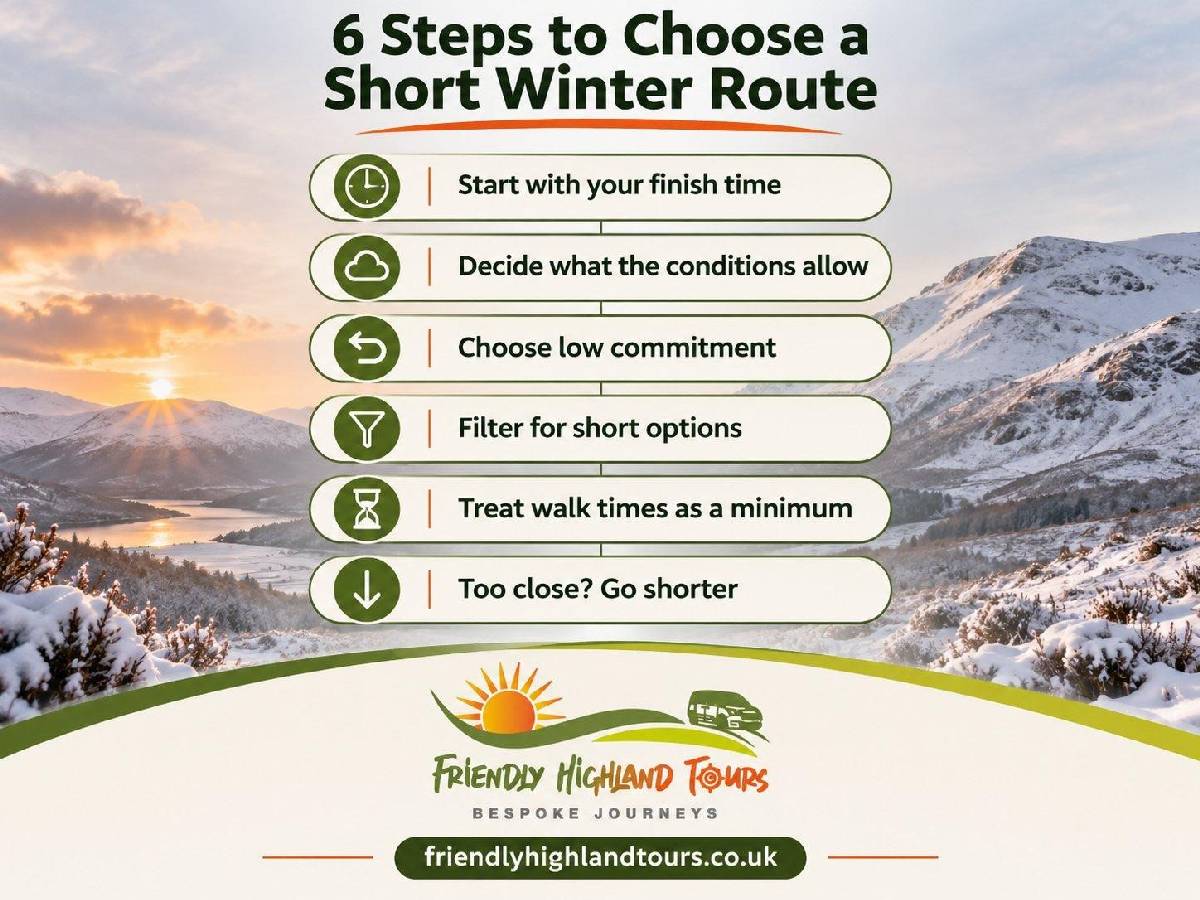
- Start with your finish time. Decide first when you need to be back at the car with light to spare. Everything else then fits around that time. This stops an appealing route from quietly stretching your day.
- Decide what kind of day the conditions allow. Use the forecast and what you know about the snow line and ground conditions. Choose the type of route before you choose the route itself. A low-level sheltered route and a higher exposed route lead to very different days. Hills and low ground behave very differently in a Highland winter. This choice affects your day more than the specific route does.
- Choose low commitment when anything is uncertain. Look for lower ground, fewer burn crossings and fewer sections that depend on navigation. An out-and-back route lets you turn round at any point without consequence. A linear route or a circuit with one committing section removes a clean way out. The freedom to turn back matters most when the weather changes fast and a stream can become impassable.
- Filter for short options. Route-planning platforms help at this stage. OS Maps lets you filter routes by difficulty and length so you can find shorter outings quickly. This saves you from scrolling through the classic big days. Use the filter to build a shortlist and then apply your own judgement. A filter knows the distance but not the snow line, the burn levels or the state of the access road. The list of easy Highland stops for visitors who prefer short walks covers gentle options near Inverness and Loch Ness.
- Check the time estimate. Published walk times generally assume reasonable conditions. Snow, ice, soft wet ground and route-finding in poor visibility all slow you down. They also cost more effort and the effect builds over the day. Treat any stated time as a minimum and not as a realistic estimate. Aleman’s guide on why Highland routes take longer than they look on a map explains how to read a route more realistically.
- Too close? Go shorter. This is the step people tend to skip. Add your buffer to the route’s estimated time and compare the total to your available daylight. A route that comes near the edge is the wrong route for today. Drop to a shorter option instead of spending the margin you built in. That margin covers the slow going and the detour around a flooded burn. It also covers the extra twenty minutes spent faffing with crampons.
Aleman’s tip: Make every important decision at the kitchen table before you leave. This method never asks you to judge risk while you are tired, cold and running out of light.
Setting Your Start Time and Turnaround Point
The timing becomes a simple process once you have chosen the route. Work through the steps below in the order shown.
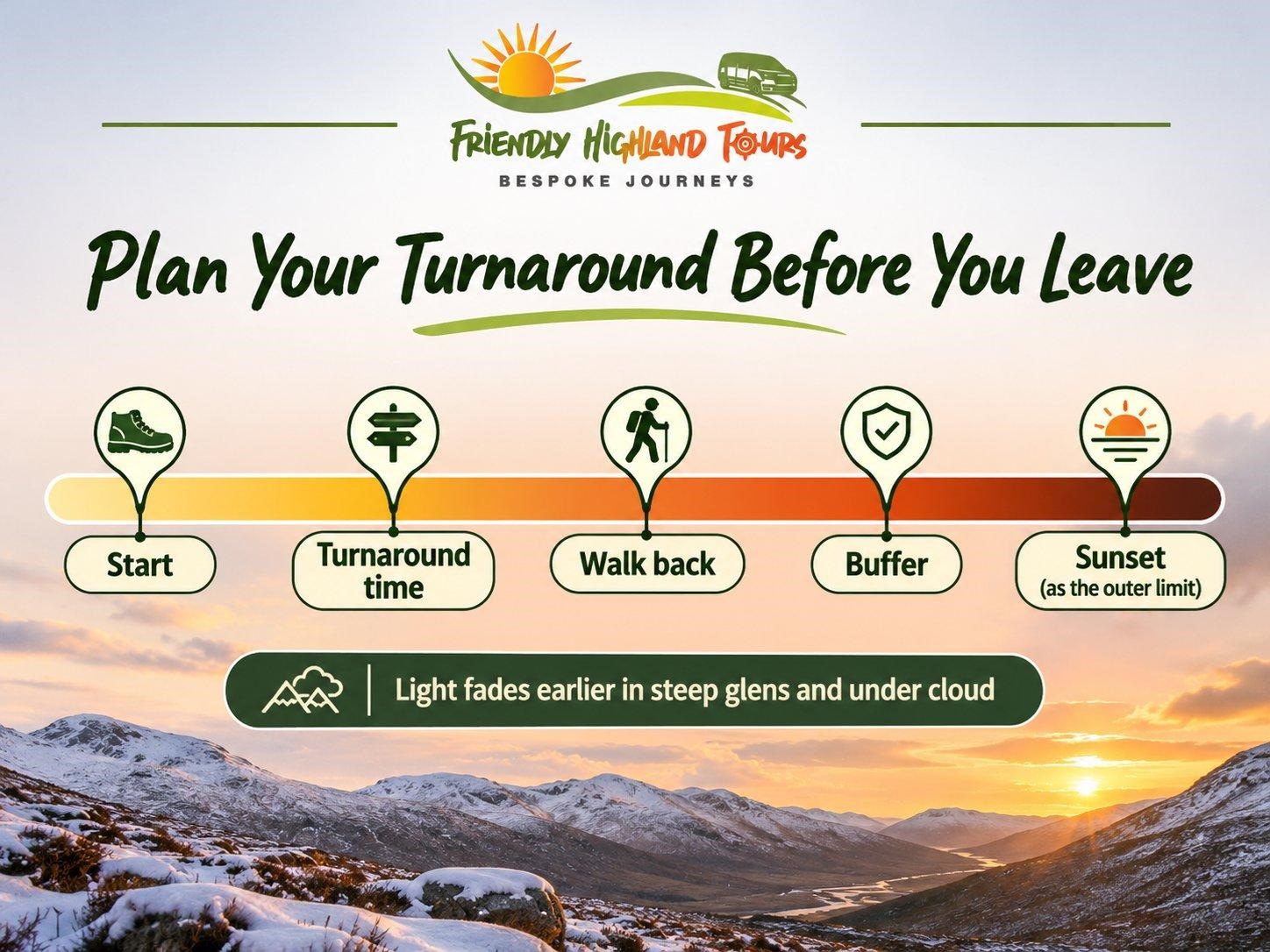
Look up the day’s actual figures. Check sunrise and sunset for your date and the area where you are walking. Check the current forecast shortly before you go as well. Daylight changes noticeably across the winter and varies across the Highlands. A figure from last month or from a different glen is not good enough. The Met Office forecast and a local sunrise and sunset lookup take about a minute each. Mountaineering Scotland is another useful source for Scottish winter hill conditions and advice. Anyone heading onto higher ground should also check the Scottish Avalanche Information Service. It gives daily forecasts for six mountain areas from mid December to about mid April.
Think about light quality as well as the clock. Usable walking light in a steep glen under thick cloud ends well before the published sunset. Treat sunset as the outer limit of a window that has been narrowing for some time.
Add a buffer before your finish time. Allow time for slower winter pace, route-finding and retracing your steps. No official figure exists for this buffer and it comes down to your own judgement. Make the buffer more generous in harsher conditions and on routes that need more navigation.
Count everything that isn’t walking. The drive, a slow or blocked road, parking and getting your kit on all come from the same time budget. Roads can be blocked and snow gates closed during a Scottish winter. Expect the journey to take longer than it would in June. Have a backup plan in case the approach road is not open. Safe winter travel in the Highlands starts before you reach the path. The guide on whether to self-drive or book a local guide in the Highlands covers seasonal driving conditions and snow gates.
Fix your turnaround time before you leave. Write your turnaround time down or set an alarm before you leave home. A turnaround time set in advance is a firm decision. A time judged on the hill with the summit looking close becomes a negotiation you will usually lose.
Then stick to it. Turn round when you reach your turnaround time short of your goal. The destination always feels nearer than it really is. Being late in a Highland winter brings darkness, falling temperatures, a rising burn and a long drive on a worsening road. These problems all build up at the same time. Nothing on the hill is worth spending the margin you set aside to get home.
Aleman’s tip: Start your walk early in the day. The clocks change in late October and this moves usable daylight firmly into the earlier part of the day. Early starts in winter are not about ambition but about using the only light you will get.
Winter Walking Safety Check Before You Set Off
Run through this list just before you set off and not the night before.
- Current forecast for your area and date: Highland mountain weather can change rapidly. A forecast checked two days ago is of limited use.
- Access to the start point: Check that the approach road is open and passable. Roads can be blocked and snow gates closed in winter. Allow enough time to reach the start.
- Someone knows your plan: Share your route, start time, turnaround time and expected finish time. Tell this person when to raise concern about not hearing from you.
- Navigation you can use in poor visibility: Carry a map and compass and know how to use them. Bring any digital navigation you rely on and make sure the charge will last. Good navigation matters most when visibility is worst. Mobile signal can drop in many glens so download your maps before you leave.
- Head torch, spares and warm layers: Pack them on the assumption that you may finish in the dark.
- A willingness to change the plan: Conditions on the ground may not match what you expected. Be ready to shorten the route, delay the start or abandon the walk.
Choose a shorter and simpler walk when you cannot confirm an item on this list. The forecast may be unclear or the road status may be uncertain. You may also doubt that the burn will be crossable on the way back. Going another day is also a good choice. A short winter route gives you room to make that decision calmly.
Frequently Asked Questions
Is January Still Winter for Walk Planning?
Meteorological winter runs from December to February and includes January. Astronomical winter starts at the December solstice and also includes January. Met Office regional data names January as the coldest month in eastern Scotland. Short daylight and winter ground conditions last through the whole month under either definition.
Does Meteorological or Astronomical Winter Matter?
The difference does not matter much when you plan a walk. The two definitions have different start and end dates. Meteorological seasons use whole calendar months while astronomical seasons follow the solstices and equinoxes. Neither definition tells you anything useful about the day you are walking. The real daylight and conditions on your date and in your area are what matter. Check these before every walk.
How Is Highland Winter Walking Different?
Ordnance Survey’s guidance draws on Scottish Mountain Rescue expertise and points to several differences. Weather changes rapidly across snow, ice, thaw and freeze. Good navigation matters far more in poor conditions. Heavy rain and snowmelt can make the smallest streams impassable. Blocked roads or closed snow gates can affect access to the start of a walk. The guide also notes that some simple summer walks become serious mountaineering in winter.
Can I Trust Online Walk Times in Winter?
Use online walk times to compare routes and not to plan your day. Tools like OS Maps are useful for filtering by length and difficulty to find shorter options. Their time estimates generally assume reasonable conditions. They do not allow for snow, ice, wet ground, route-finding in poor visibility or the slower pace these bring. Add your own buffer to any estimate. Pick something shorter when the estimate already comes close to your available light.
My Advice: Let Winter Daylight Lead Your Highland Route
Safe short walking in a Highland winter is not about knowing the right routes. It is about matching the length and commitment of the day to the daylight and conditions in front of you. You make this decision fresh each time because nobody can look it up for you. Set your turnaround time at home before the route gets a vote and then stick to it. Check the real daylight, the current forecast and the access road just before you go. Do not rely on general advice you have read and that includes this guide.
Want a winter day out without planning a walk yourself? My Loch Ness Private Tour runs all year round and stays close to Inverness. It is a good choice for anyone hoping to see Loch Ness in winter. The Whisky Private Tour also runs all year round. Its distillery visits suit the days when the hills are out of reach. Call me on +44 7848 460 773 or get in touch to plan a shorter Highland journey in winter.
Aleman is a local guide who leads Friendly Highland Tours. He has lived in the Highlands for over thirty years. He knows the land through real journeys on quiet roads, lochs, and glens. Families and small groups travel with him for calm days and warm stories. Each guide he writes comes from experience on the road and careful consideration.